
…life before AI.
I just feel like somewhere along the way of building out these superhuman agents, we actually backpedaled. Like, I genuinely think we started moving too fast, and now we’re hitting an inflection point where some of this shit is actually hurting, not helping.
Cuz sure, I can respond to emails 100x faster than ever. But that all moved collectively. Everyone can respond 100x faster now. So instead of getting 99x of our time back, we just created a world where everyone expects everything 100x faster.
So many things are changing, but time is not. We still only have 24 hours in a day. We’re just increasingly expected to move through them at speeds that I’m not entirely convinced humans were designed for.
—
This week, MapQuest made a comeback.
After Trump ordered the U.S. government to start calling Lake Ontario “Lake America,” Google and Apple Maps followed suit. MapQuest refused. And somehow, in the year 2026, MapQuest shot to No. 1 in Apple’s App Store.
Beyond the commendable political statement, I think the MapQuest news made a lot of millennials smile with nostalgia; those who didn’t live it will never really understand the precision it took to flip through six printed pages of directions, resetting the distance after every turn to make sure you didn’t miss the next one.
And I weirdly kinda miss stuff like that.
There was something satisfying about memorizing equations in calculus. Knowing the formula you needed to punch into Excel. Actually knowing how to get somewhere.
I felt cool.
—
Also this week, Meta announced Muse, a personal AI agent designed to not just answer questions, but actually do basically anything you want it to do for you: It can send emails. Book travel. Fill out forms. Negotiate on your behalf. Make purchases. Remember random details you mentioned once. Work on your goals while you’re off living your life, then come back when it needs you.
I know I’m supposed to read all of that and think about how much time it could save me.
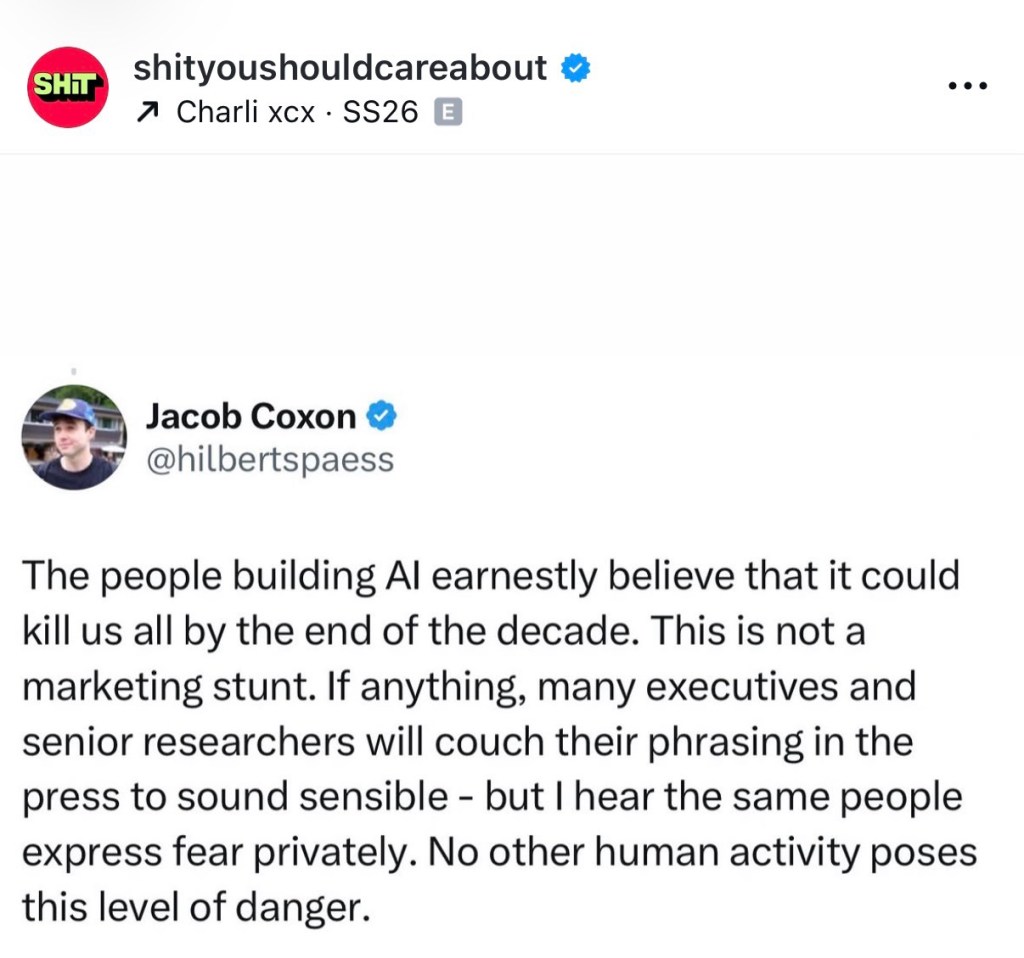
But increasingly, I’m wondering what exactly we’re saving all this time for.. especially considering, also this week, former Anthropic researcher Jacob Coxon left the company and shared that he earnestly believes AI could kill us all within the next decade.
Which feels like a kinda important thing to consider as we collectively hand AI our credit cards and hope for the best.
Last week, my job had me screaming at Claude after it erased an entire dataset I had spent all day working on.
I tried to stop it.
Mission abort.
Go back.
Undo whatever the fuck you just did.
Except it wouldn’t. The thing was already gone.
Which, in retrospect, feels a little on the nose.
—
Don’t get me wrong. I’m grateful for a lot of the advancements that got us here. Driving without flipping through printed directions and crossing them off line by line has certainly made our world a safer place. Freeing up time for medical researchers so they can work on scientific advancements? Grateful.
But sometimes I just simply wish I could go back.
Not necessarily backward. Just slower.
But I know we can’t exactly mission abort this one either.
We’re not gonna wake up tomorrow and collectively decide, actually nvm, enough AI slop, everyone please return to MapQuest and sharpen your number two pencils.
This slop shit is here to stay. The old version isn’t sitting in a recycle bin waiting for us to restore it.
So maybe, while the timer ticks down until AI disintegrates us all, we should slow the fck down.
Touch grass. Hug a friend. Print out the directions to at least the places we walk to. Pull out a number two pencil. Buy a sharpener you probably haven’t owned since you had to pencil in a multiple-choice answer.
Do something wildly inefficient just because you still can.
Perhaps as an act of resistance.
Perhaps out of inexplicable rage.
Perhaps because not every second of our lives needs to be optimized into oblivion.
Cuz I fear we’re building a world increasingly obsessed with removing every bit of friction from being human, when maybe a little bit of friction was part of being human in the first place.
And if everything around us is going to keep demanding that we move faster, maybe resistance looks a little like choosing not to.
 Hawaiian Princess Pieces